×

The Standard e-Paper
Smart Minds Choose Us
 The Standard Group Plc is a
multi-media organization with investments in media platforms spanning newspaper
print operations, television, radio broadcasting, digital and online services. The
Standard Group is recognized as a leading multi-media house in Kenya with a key
influence in matters of national and international interest.
The Standard Group Plc is a
multi-media organization with investments in media platforms spanning newspaper
print operations, television, radio broadcasting, digital and online services. The
Standard Group is recognized as a leading multi-media house in Kenya with a key
influence in matters of national and international interest.

Audio By Vocalize
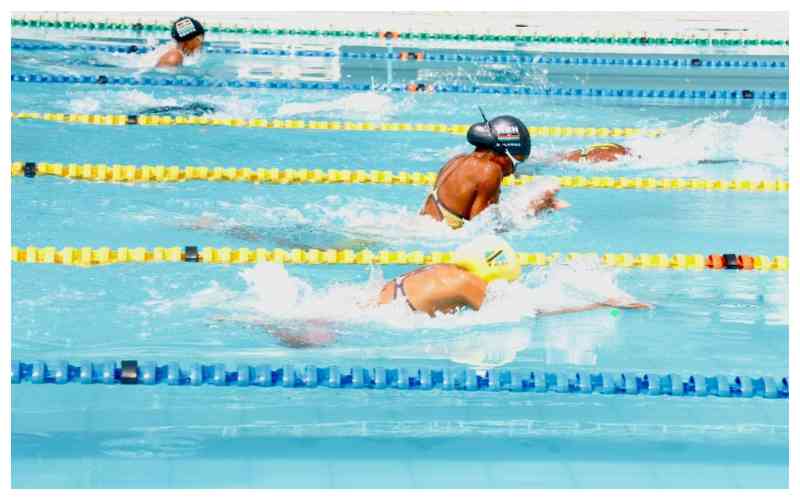
The stadiums going up across this country prove what we can do when we decide something matters. Kenyan swimming still has one 50-metre pool, nine lost years, and a story it keeps telling itself about Beijing.
Begin with the concrete because it settles the argument before it starts.
At Jamhuri Grounds on Ngong Road, Talanta Stadium—a 60,000 seater facility—now stands where a showground once stood. Ground was broken there in March 2024. Renovations continue at both Nyayo, Kasarani and Kipchoge Keino stadiums.
In June next year, the continent arrives for the 2027 Africa Cup of Nations (Afcon), to play in venues that, three years ago, either did not exist or did not function.
Understand what that proves. This country can commission a venue, finance it, engineer it and deliver it to continental standard in about two years once it decides the thing matters.
The will, the money and the technical capacity are all demonstrably in the room. That is a real achievement, and this column has no interest in pretending otherwise.
Now drive 11 kilometres north-east, to Kasarani. Our own federation, Kenya Aquatics, describes the pool there as the only 50-metre facility of its kind in East Africa. It was built for the 1996 African Championships. It is 30 years old. It is one competition-standard long-course pool for fifty-five million people and, essentially, the entire national aquatic estate.
We have not built a serious pool in this country in three decades. Not because we could not. Because nobody in swimming ever asked with enough conviction to be heard.
Our athletes deserve better than to be used as a stick, so start with them.
In Oran this May, Haniel Kudwoli went 28.62 in the 50 breaststroke and took bronze, breaking his own national record.
Sara Mose stood on the podium in the 100 freestyle in 57.49. In Glasgow last month, four Kenyans set a national record in the mixed medley relay, and one of them became the first Kenyan woman ever to reach a Commonwealth semi-final.
These are real performances by serious young people who are getting faster every season. They are also, taken together, the ceiling of what raw talent can reach inside a ruin.
Because here is the whole record, plainly stated. Kenya has never won an Olympic swimming medal. Not one, in the entire history of our participation.
We came closest in August 2008, when a 21-year-old Jason Dunford swam 51.14 in the 100-metre butterfly at the Beijing Water Cube, briefly held the Olympic record, and finished fifth in the final.
He was the first Kenyan to reach an Olympic swimming final, and the first to do so on merit rather than as a wild card. He had learned to swim at a Nairobi preparatory school, in a pool the overwhelming majority of Kenyan children will never enter.
Stay informed. Subscribe to our newsletter
Eighteen years later, that remains the summit. We have been living off it ever since, the way a family lives off an inheritance nobody is replenishing.
Between September 2014 and October 2023, the national swimming federation did not hold a single election. Nine years. Read that again, and then ask what would happen to any other institution in this country that declined to constitute itself for the better part of a decade.
The world governing body suspended Kenya provisionally in December 2019. In June 2022, it dissolved the federation outright and installed a stabilisation committee to run Kenyan swimming, because Kenyans had spent years proving they could not be trusted to run it themselves.
Elections were finally scheduled for July 2023 and halted at the last minute by a Kenyan court, on the application of Kenyans, in a quarrel between Kenyans.
The global body then wrote to warn that our swimmers, coaches and officials risked being shut out of international sport altogether.
For nearly four years our athletes competed as neutrals. At the 2022 Birmingham Games and the 2023 World Championships in Fukuoka, Kenyan swimmers raced under the flag of a suspended federation.
Not for doping. Not for fraud. But just because grown men and women would not hold a meeting.
The rot runs further back. The federation president of the previous era resigned in early 2017 after his arrest in connection with the Olympic kit scandal that disgraced us in Rio.
When Commonwealth selection came round in 2022, it was reported that half the swimmers chosen were children of the federation's most senior officials, while athletes training abroad were ruled ineligible for not swimming trials at home, as though the offence were going to find a pool.
Now do the arithmetic on the human cost. A child who was 12 years when the first suspension was handed down is 19 years today.
The precise years in which a swimmer is manufactured evaporated: the training volume, the ratified times, the reliable calendar, the belief that any of it counts for anything.
Ask any coach in Mombasa or Kisumu how many stopped coming. That cohort is gone, and no curriculum retrieves it.
Beneath all of it sits the water, or rather its absence. Read the entry list for a national age-group meet and you are effectively reading a schedule of school fees.
A boy in Iten who wants to run needs shoes, and sometimes not even that.
Another boy in Iten who wants to swim needs a pool, a coach, a membership, transport, a kit and entry fees indefinitely. Our greatest sporting culture is savagely meritocratic.
Our swimming is inherited, like land.
The stadium programme is not the enemy of this argument. It is the proof of concept.
We have just demonstrated that when Kenya decides a facility exists, it exists. Apply the same machinery.
Ten fifty-metre pools in ten years, built to international specification, sited where the drowning is, on the coast, on the lake, in the major towns, and not clustered in Nairobi's leafy suburbs. Kiambu's new facility in Thika already shows that this is politically achievable at the county level.
The arithmetic is not frightening. Even at half a billion shillings apiece, which is generous for a competition tank with filtration, heating, plant and modest stands, ten of them come to about five billion shillings, spread across a decade.
Set against what this country now spends annually on sport, that is a rounding error. This is not a money problem. It has never been a money problem. It is a nerve problem.
Two conditions, and they are not negotiable. Build to specification, or you have built expensive bathtubs. And endow the maintenance from day one, because construction has never been our weakness. Custody has.
Here is where we can leapfrog rather than catch up, and where the new generation of administrators has to think differently from the last.
Put certified electronic timing in every one of those pools. Touchpads, approved starting systems, ratified results.
Right now, a Kenyan swimmer's time is only fully believed once they have flown somewhere to swim it again. That is a poverty tax, and it is a hardware problem with a hardware solution.
Then publish everything. A national results database, open and searchable, tracking every registered swimmer from the age of nine.
This is the single cheapest reform available to us and the most devastating, because a public progression table cannot be argued with at a selection meeting.
You cannot quietly put an official's child on a Commonwealth team when the country can pull up the splits on a phone. Transparency is not a virtue here. It is a selection method.
Use the tools that have become almost free. Underwater and above-water video, stroke-rate and split analysis, turn and breakout timing, wearable load monitoring.
A camera and analysis software cost a fraction of what an overseas training camp costs, and they turn a decent club coach in Kisumu into a technical coach.
Connect our swimmers abroad to national coaching via video, rather than losing them entirely to the diaspora.
Build the pools themselves as modern infrastructure. Solar thermal heating. Water recycling and high-efficiency filtration, so that a 50-metre pool in a water-stressed country is defensible to a sceptical taxpayer and a hostile county assembly. Modular stainless-steel construction that shortens the build time from years to months.
And digitise the governance, because that is what actually broke. Online athlete and club registration. A verified electronic membership register.
Electronic elections held on a published calendar. Audited accounts posted quarterly on a website anyone can open. Nine years of paralysis were, at bottom, a fight over who was on a list. Publish the list and the fight ends.
None of that requires a stadium bond. It requires a decision.
In June the whole continent will be in Jamhuri to watch football in an arena we willed into existence in two years because we decided it mattered. That is the lesson, and it has almost nothing to do with football.
For a few minutes in Beijing, a Kenyan was the fastest man an Olympic pool had ever seen over a hundred metres of butterfly. We have spent eighteen years agreeing among ourselves that it was a fluke.
It was not a fluke. It was a preview of a country we never bothered to build.
Pour the water.





Subscribe to our newsletter and stay updated on the latest developments and special offers!








 join
join