×

The Standard e-Paper
Fearless, Trusted News
 The Standard Group Plc is a
multi-media organization with investments in media platforms spanning newspaper
print operations, television, radio broadcasting, digital and online services. The
Standard Group is recognized as a leading multi-media house in Kenya with a key
influence in matters of national and international interest.
The Standard Group Plc is a
multi-media organization with investments in media platforms spanning newspaper
print operations, television, radio broadcasting, digital and online services. The
Standard Group is recognized as a leading multi-media house in Kenya with a key
influence in matters of national and international interest.

Audio By Vocalize
Leadership wrangles at the Friends Church (Quakers) under the Nairobi Yearly Meeting (NYM) have escalated into a bitter dispute over governance, financial control, and local congregations' autonomy, leaving one of its prominent churches closed for eight months.
The dispute at Friends International Centre (FIC), the NYM headquarters meeting along Ngong Road in Nairobi, has pitted the church secretariat against local leaders and congregants, with the two sides trading accusations of constitutional violations, abuse of power and mismanagement.
The Standard has established that at the centre of the dispute is a long-running disagreement over whether FIC has the authority to recruit and pay its pastors directly or whether all clergy should be employed and managed by the NYM secretariat.
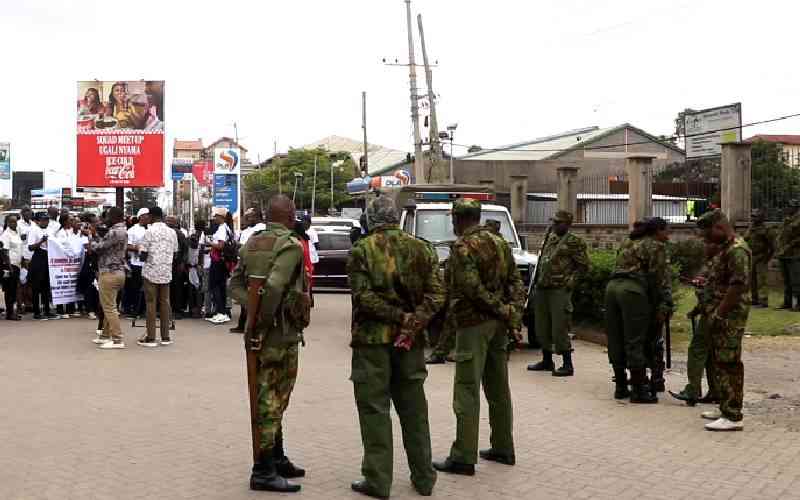
When The Standard visited FIC during a normal Sunday service, the church remained closed and was guarded by armed police officers. Outside the gate, a section of congregants sang and danced as they called for the reopening of the sanctuary.
The group, which has been branded a "rebel" faction by the church leadership, said it had been denied access to the sanctuary for eight months.

The dispute can be traced to a 1992 Memorandum of Understanding between FIC and the NYM secretariat. The agreement allowed FIC to employ and remunerate its pastors directly, provided the secretariat participated in their vetting and recruitment.
The first pastor employed under the arrangement served until 1997, when Agrey Mukirima took over. In 2012, Mukirima was promoted to General Superintendent, creating a vacancy at FIC.
Walter Bulimu, then an employee of the secretariat, applied for the position and was appointed senior pastor after an interview.
Over the years, more pastors were recruited to serve various ministries, including children, youth, women and men. Their salaries, according to church members, ranged between Sh90,000 and Sh130,000, significantly higher than those paid to pastors employed directly by the secretariat.

However, this disparity became a source of tension. The secretariat, led at the time by General Superintendent Rev John Davis Webere, Deputy General Superintendent Nathan Lihanda and Administrative Secretary Moses Adika, sought to end the arrangement that allowed local meetings such as FIC to hire pastors directly.
The officials argued that clergy should operate under a common system to promote fairness and uniformity across the church.
In an earlier interview, Webere, who resigned last month, said the church had to be governed by its constitution rather than individual interests.
"A society without guiding principles breeds chaos," he said.
Stay informed. Subscribe to our newsletter
ALSO READ: Friends no more? The power and property wars dividing Quaker Church
FIC is one of about 160 local churches under NYM, which has 25 monthly meetings and 21 mission stations.
Webere said the latest phase of the conflict began in 2023 after leadership nominations at FIC allegedly failed to comply with constitutional requirements.
The church constitution requires office holders to be fully paid-up and active members.
Some members disputed the nominations and petitioned the secretariat. Its constitutional committee subsequently investigated the matter and dissolved the FIC leadership.
A caretaker committee was installed before a new leadership team was nominated four months later.

The new leadership, however, was also accused of rebellion after it resisted the transfer of six pastors to the secretariat and opposed an increase in the local monthly budget from Sh190,000 to Sh390,000.
The disagreement escalated, resulting in the suspension or excommunication of the pastors and the branding of some leaders as members of a rebel faction.
The pastors named in documents and accounts reviewed by The Standard are Walter Bulimu, Florence Irungu, Simone Khaemba, Gilbert Watima and Fanuel Demesi.
The dispute further divided the congregation, with members accusing the secretariat of selectively applying the church constitution and using internal networks to identify dissenters.
"We are not against pastors being under the yearly meeting," said Lawrence Andove, a congregant. "But we want to continue paying them directly as we have always done."
He claimed 35 members and six pastors were issued suspension letters and barred from the church premises.

The suspended members subsequently obtained a court order maintaining the status quo pending further proceedings. Andove, however, alleged that the secretariat disregarded the order by enforcing the suspensions and installing new leadership.
Lihanda, now acting General Superintendent, rejected the interpretation that local meetings could operate independently of the yearly meeting.
"You can't have branches hiring staff without the head office's knowledge," he said.
ALSO READ: Wrangles hit Quaker Church as members protest lack of transparency and property control
But Prof David Kikaya, a senior elder at FIC, said the secretariat had overstepped its mandate.
"Our constitution is clear: local meetings must nominate their own leaders. NYM is a coordinating body, not a ruling one," he said. "What we're witnessing is micromanagement and the erosion of grassroots legitimacy."
Kikaya said the dispute had weakened confidence in the church's leadership because some members did not recognise leaders imposed through the contested process.
Benson Ongocho, another congregant, accused the secretariat of influencing pastors to target critics during sermons. "The preaching has been weaponised," he said.
The leadership dispute has also spilt into the management of church assets.
In 2015, the secretariat established Quaker Investment Company Limited (QICL), a third-party company mandated to manage church assets, including land, buildings and businesses.
Church members estimate the assets to be worth billions of shillings.

Kikaya questioned the company's financial accountability, claiming it had not provided audited accounts to members.
"The concept was never properly communicated. Up to now, the company has not released any audited accounts," he said.
One of the most contentious issues concerns a five-acre parcel of land acquired by FIC.
According to church members, the secretariat sought to transfer the title deed from FIC to QICL, a move opposed by local elders.
"How can we hand over this property to a leadership whose legitimacy is contested?" Kikaya posed, adding, "Nairobi Yearly Meeting, founded in 1987, is like a great-grandchild trying to seize property from its elders."
Lihanda, who is also a director of QICL, confirmed that church assets are held by six trustees, who are constitutionally required to rotate every five years.
Records seen by The Standard showed the trustees had held their positions since 2015.
Lihanda defended the management of the assets, saying all property decisions had been undertaken transparently.
"All property decisions have been transparent and fully implemented. Some individuals are just bitter because they can't loot church resources," he said.
The dispute eventually culminated in the closure of FIC.
Presiding Clerk of NYM Ben Simiyu said the decision to suspend physical worship services was taken in February 2026 after the situation at the church deteriorated.
Simiyu said the church had descended into what he described as "chaos, anarchy and lawlessness", with some individuals allegedly usurping authority to run services, collecting funds without authorisation, holding parallel services in tents and sharing false information with the media.
He also alleged that members had fought inside the church and compound, threatened others, engaged in gender-based violence, threatened to strip naked and poured water on worshippers during prayer.
He said threats had also been made against life and property, causing trauma to children.

"Before the closure of the centre, some individuals attempted to break doors and force entry into the church while issuing threats," Simiyu said.
He added, “A member was violently assaulted and sustained severe bleeding. The shedding of blood within our place of worship grieved us profoundly. To all who have suffered fear, injury, or trauma, we stand with you in prayer and compassion. Your safety and wellbeing matter deeply to us.”
Simiyu said the decision to close the church was intended to prevent further confrontation.
"In a nutshell, FIC was operating outside the church's constitutional and governance framework. The church was indeed closed. This was necessitated by the fact that people fought and there was bloodshed. We cannot allow the house of God to be turned into a battlefield," he said.
He said tensions remained high and the atmosphere necessary for worship had been lost.
“We closed it to allow both parties to reflect. At the right time, the doors will be opened, he said. "Matters of a criminal nature have been reported to security for investigation.”
Simiyu also added that several members, including the suspended pastors, had filed six cases in court.
He said four had been decided in favour of the secretariat, while two were awaiting submissions on September 28 and November 5.
However, while the parties battled it out in court, the closure has left congregants holding some services online.
Allan Agunda, a member of FIC, said the closure had disrupted worship and church activities.
“Our plight today is that the church should be reopened because our kids are suffering and our youth have dispersed to other churches,” he said.
He said members were particularly concerned about the management of the church's land.
ALSO READ: Peace has economic value, Mudavadi tells Church
“He wants the title deed of this church, which we cannot allow as members. We know they want to do business with it and that is one of the things we are against,” Agunda said. “Those closing the church are going against the law of God. Let them open the church for people to worship.”
Lucy Ayuya, a member of the United Society of Friends Women group, questioned the legacy of the church's current leadership.
"I'm asking Ben Simiyu, what is the legacy that you are leaving? Leadership is for a period of time. When you leave, will your legacy be that you closed God's church?" she asked.
Despite the bitter dispute, the congregants said they were willing to pursue dialogue.
"If there's anything that went wrong, we ask them to come and have a sit-down so that we solve it. This is God's temple," Agunda said.
Some members said they had unsuccessfully sought the intervention of senior political figures associated with the church, including Prime Cabinet Secretary Musalia Mudavadi and Public Service Principal Secretary Jane Imbunya.
"Mudavadi, this is your home. During the electioneering period, you always come here. Where are you going to come if you don't come during such moments?" asked Jacob Saya, another member.
Simiyu acknowledged that several local meetings had experienced prolonged conflicts, resulting in some members withdrawing from worship and reducing their support for the church.
He said the disputes had slowed the growth and development of some congregations.
Friends Church in Thika, Kiambu County, had also experienced leadership problems, although Simiyu said the dispute was nearing resolution.
In a notice, Simiyu also warned leaders and members of Kabiro Local Meeting and their allies at Friends Church Emmanuel under Kawangware Monthly Meeting to resolve their differences.
"Kabiro Local Meeting, together with their allies in Friends Church, Emmanuel, under Kawangware Monthly Meeting, are hereby put on notice to put their house in order,” he noted.
He added, “ Should they fail to do so within the next three months, very drastic action will be taken against everyone who will be found to have contributed to the instability of this once very vibrant and highly productive church.”
On FIC, Simiyu said the suspension of physical worship was intended to provide an opportunity for reconciliation.

"It is our humble belief that the physical suspension of worship services at FIC has given all of us time to reflect deeply and seek God's forgiveness and mercy," he said.
He urged members who had filed cases in court to consider resolving the disputes through the church's internal mechanisms.
"FIC members belong to NYM and hence we appeal to those who have filed numerous cases in court to consider having them dealt with through our internal church mechanisms. Continue praying about the restoration of FIC, NYM's headquarters meeting," he said.
Simiyu said plans were under way to reopen the church, but insisted that its operations would have to comply with the church constitution.
"Every effort is being made to address the issues that led to the suspension and serious plans are underway to reopen the sanctuary," he said.
He said the move would be guided by resolutions passed at the 39th Annual General Conference held at Rafiki Centre in Vikwatani.
The conference resolved that the secretariat and church leadership strengthen mechanisms for resolving conflicts through structured dialogue and ensure compliance with church policies, manuals and guidelines.
The resolution also established a role for elders in resolving disputes, including intervening where local governance is non-existent, unable to act or delayed.
According to the Vikwatani declaration, matters that cannot be resolved at the local level should be escalated to higher-level elders for consultation, mediation and action.
The conference further resolved that legal cases involving the church be handled effectively, with progress communicated to the wider Quaker community.




Subscribe to our newsletter and stay updated on the latest developments and special offers!






 join
join