×

The Standard e-Paper
Kenya’s Boldest Voice
 The Standard Group Plc is a
multi-media organization with investments in media platforms spanning newspaper
print operations, television, radio broadcasting, digital and online services. The
Standard Group is recognized as a leading multi-media house in Kenya with a key
influence in matters of national and international interest.
The Standard Group Plc is a
multi-media organization with investments in media platforms spanning newspaper
print operations, television, radio broadcasting, digital and online services. The
Standard Group is recognized as a leading multi-media house in Kenya with a key
influence in matters of national and international interest.

Audio By Vocalize
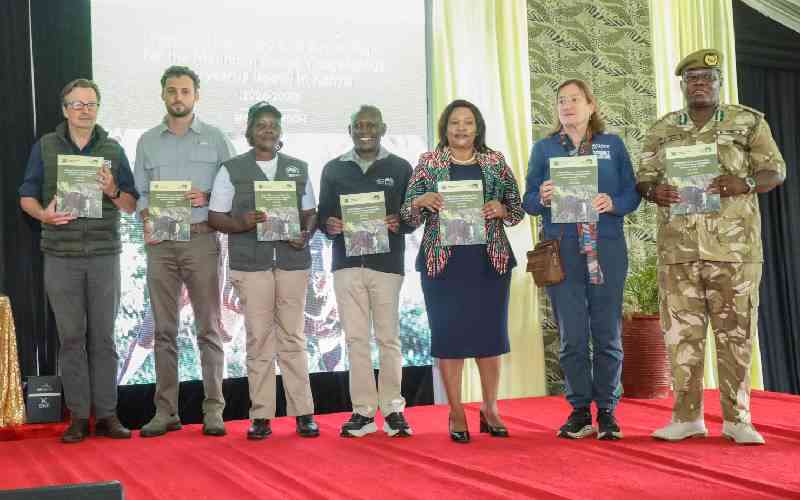
Environment and Forestry CS Rebecca Miano (centre), conservation officials and partners display the National Recovery and Action Plan for the Mountain Bongo (2026–2030) during its launch at Mount Kenya Wildlife Conservancy. The plan targets a 50 per cent increase in the national bongo population by 2030 and 750 animals by 2075. [Amos Kiarie, Standard]
The death of a single breeding female could set the recovery of Kenya’s mountain bongo back by about three years, a stark measure of how close the country’s rarest forest antelope is to disappearing from the wild.
With fewer than 65 mountain bongos now surviving in the wild, poaching, habitat destruction, disease and the isolation of small populations mean that the loss of even one or two adult females can sharply reduce the species’ ability to reproduce.
Now Kenya is attempting to rebuild the species from these dwindling remnants, with a long-term target of 750 mountain bongos by 2075 through breeding, forest restoration, scientific monitoring, community conservation and carefully managed reintroductions.
The urgency is heightened by the fact that the remaining wild animals are confined to highly fragmented habitat.
Confirmed populations occur in the Salient section of Aberdare National Park and the Maasai Mau forest block, while the species has disappeared from other forests where it was once recorded.
In Mount Kenya’s Ragati Forest, the last bongo was recorded in 2019. In Eburu Forest Reserve, the last confirmed record came from a camera trap in July 2020.
The second edition of Kenya’s National Recovery and Action Plan for the Mountain Bongo (2026–2030) seeks to reverse that retreat by securing the remaining wild populations while creating new populations through breeding and reintroduction.
Environment and Forestry Cabinet Secretary Rebecca Miano said the mountain bongo’s recovery was more than a wildlife conservation project because the species is found only in Kenya and is critically endangered.
“Its recovery is therefore more than a wildlife project. It tests how we govern the mountain forests that supply water, store carbon, support agriculture and tourism and sustain communities,” Miano said.
She said securing the bongo also meant protecting a wider national asset, noting that the Constitution requires the State to conserve biodiversity and protect genetic resources.
Miano said the new plan translates those obligations into specific priorities, responsibilities, budgets and measurable results while supporting Kenya’s National Wildlife Strategy 2030 and the Kenya Wildlife Service strategic plan for 2024–2028.
"The new strategy also sets a target of increasing the national mountain bongo population by 50 per cent by 2030 and building towards a self-sustaining population of 750 by 2075," the CS said.
The first year of implementation will focus on securing and growing wild populations in at least two ecosystems, maintaining increasing populations in at least two breeding sanctuaries and preparing at least one suitable forest release site within the species’ former range.
But Miano acknowledged that the new plan comes after gaps in implementation of the first recovery strategy.
Stay informed. Subscribe to our newsletter
A review of the previous plan found that only 28 of 129 activities were fully implemented.
The second edition therefore introduces a coordination secretariat, clearly assigned responsibilities, at least two National Bongo Task Force meetings each year and annual, mid-term and final reviews.
The plan estimates that about Sh400 million will be required over five years.
Miano said development partners, philanthropy and responsible private capital should align their support with the costed national framework, accompanied by transparent reporting on expenditure and outcomes.
She also warned that development decisions affecting bongo habitat must take conservation into account before projects are approved.
“Any forest use, infrastructure or investment proposal that may affect critical Bongo habitat must be based on credible environmental assessment, avoidance of damage and enforceable mitigation,” she said.
Miano said communities living beside mountain forests were also central to implementation, with conservation expected to create jobs, enterprises, restoration opportunities and participation.
She said Kenya would work with the IUCN Species Survival Commission on population and genetic viability, disease risks, release standards, hormone monitoring, independent peer review and specialist capacity.
By 2030, she said, success should be visible in the forests and verifiable in the data through more bongos in secure habitat, declining illegal and harmful activity, healthy and genetically diverse managed populations, a credible release pathway and communities benefiting from landscape recovery.
The plan sets working population targets of 300 bongos in the Aberdares, 250 in Mount Kenya, 100 in the Mau and 20 each in Eburu, Londiani, Chepalungu, Cherangani and Mount Elgon — ultimately building towards a national population of 750.
Dr Robert Aruho, head of Mount Kenya Wildlife Conservancy, said the elusive nature of the animals and their dense forest habitat made accurate census difficult.
“One of the biggest challenges we had in the previous framework was bringing together the bongo numbers, which have been quite difficult to get in a census,” Aruho said.
The new plan therefore places scientific monitoring at the centre of recovery, using camera traps, artificial intelligence-assisted monitoring, GPS tracking, remote sensing and ecological research to locate animals, understand their movements and determine where populations can survive.
The mountain bongo (Tragelaphus eurycerus isaaci) is classified as Critically Endangered and is found only in Kenya’s montane forests.
Its chestnut coat, crossed by white stripes, helps it disappear into dense vegetation, while both sexes carry spiral horns. The animals feed on leaves, shrubs, herbs and vines and are closely dependent on intact mountain forests.
But their small numbers have created a conservation problem that extends beyond threats killing animals directly.
Mount Kenya Wildlife Conservancy now holds about 100 managed mountain bongos.
The breeding population has also been strengthened through international transfers. Bongos from the United States arrived last year, followed by four from Europe in April.
“They are doing well actually, and we expect the babies soon,” Aruho said.
Before release, animals will undergo veterinary screening, quarantine and acclimatisation. After release, GPS tracking, camera traps, ranger patrols and direct observation will be used to determine whether they survive and reproduce.
At Mount Kenya Wildlife Conservancy, Aruho said conservation also extends to communities living around the forest.
Residents are involved in restoring forests by supplying tree seedlings and planting them, while most bongo-related workers are recruited from within a five-kilometre radius, except where specialised technical skills are required.
“We want to make an impact in this area where the bongo lives,” he said.
Christian Lambrechts, executive director of Rhino Ark Kenya Charitable Trust, said the significance of the bongo extends beyond the species itself.
“The return of Kenya’s flagship mountain forest species — the mountain bongo — in healthy numbers to these mountain forest ranges would be the crowning glory of our efforts in forest conservation,” Lambrechts said.
For Dr Margaret Otieno, CEO and National Coordinator of Wildlife Clubs of Kenya, that work must also include helping young people and communities understand the science behind conservation.
“This science is not translated into bite-size that can be understood by the young, by the communities, by the indigenous people that live next to this wildlife, then there won't be any action,” Otieno said.
She said Wildlife Clubs of Kenya, which has existed for close to 60 years, had reached more than 10 million people and demonstrated that conservation education could build public participation.







Subscribe to our newsletter and stay updated on the latest developments and special offers!








 join
join