×

The Standard e-Paper
Home To Bold Columnists
 The Standard Group Plc is a
multi-media organization with investments in media platforms spanning newspaper
print operations, television, radio broadcasting, digital and online services. The
Standard Group is recognized as a leading multi-media house in Kenya with a key
influence in matters of national and international interest.
The Standard Group Plc is a
multi-media organization with investments in media platforms spanning newspaper
print operations, television, radio broadcasting, digital and online services. The
Standard Group is recognized as a leading multi-media house in Kenya with a key
influence in matters of national and international interest.

Audio By Vocalize
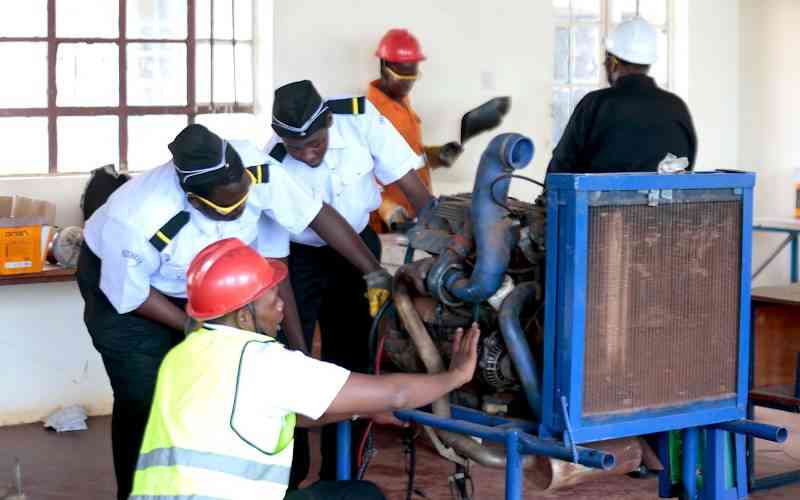
Marine engineer Rotich Tuitoek takes Pioneer Group of Schools Grade 10 learners through a practical lesson on October 16, 2026. [Boniface Okendo, Standard]
As Competency-Based Education takes shape in senior schools, learners are increasingly exploring technical subjects, but limited equipment and specialised teachers are pushing schools to share facilities to keep practical learning alive.
At 16, Trevor Mbugua is already imagining a future in which Kenyan engineers design, build and maintain ships locally.
A Grade 10 learner at Pioneer Group of Schools in Murang’a, Mbugua is studying marine engineering, a specialised field that reflects a growing interest among learners in technical subjects under the Competency-Based Education (CBE) curriculum.
For him, the appeal lies in acquiring practical skills that can be translated into solutions for real-world challenges, rather than relying solely on theoretical knowledge.
“The skills I am acquiring in engine technology are of a high standard. I believe they will enable me to contribute to building ships locally,” says Mbugua, who hopes to become part of Kenya’s future shipbuilding workforce.
His ambition illustrates how the new curriculum is encouraging learners to explore technical careers in engineering, computing, agriculture and applied sciences, areas increasingly associated with innovation, entrepreneurship and employment opportunities.
Acting Director of STEM Research and Innovation at CEMASTEA, Dr Karanja Mutitu, said
the findings demonstrate growing enthusiasm among learners for science and majority of Grade 10 learners taking Science, Technology, Engineering and Mathematics (STEM) subjects want to continue with the pathway after senior school, according to findings by CEMASTEA.
“On perception, the learners are embracing STEM. Over 95 per cent of Grade 10 learners undertaking STEM subjects indicated they would prefer to continue with the STEM pathway even after senior school,” he said.
Mutitu said the results reflected growing confidence in the Competency-Based Education curriculum.
But as more learners develop an interest in these subjects, schools are confronting a challenge on how to provide practical training when laboratories, workshops, equipment and specialised teachers remain beyond the reach of many institutions.
The emerging response is collaboration, with schools exploring ways to pool resources and share expertise to ensure learners gain exposure to practical learning.
In some cases, institutions that lack adequate facilities may need to partner with better-equipped schools, technical colleges and industry players to deliver lessons that would otherwise be difficult to organise independently.
Machakos School Chief Principal Benson Manoo said the school collaborate with other institutions in sharing facilities and expertise to support technical learning in Aviation.
Stay informed. Subscribe to our newsletter
“Some Grade 10 learners had interest in the learning area which made us explore on ways to accommodate them. We are partnering with Mang’u high school to offer the subject,” Manoo said.
He noted that the challenge is ensuring that a learner’s ambitions are not limited by the resources available at their school.
“Partnerships with technical and vocational education and training institutions, universities and industry could also expose learners to modern technologies and workplace expectations,” he said.
For Kenya to develop the technicians, engineers and innovators needed for its future economy, practical learning must become an opportunity accessible to learners across institutions, not a privilege reserved for the well-equipped few.
Resource-sharing arrangements could help bridge some of these gaps, allowing schools to access facilities collectively rather than requiring every institution to invest independently in expensive equipment.
The precise nature of any co-hosting arrangement between the two should be confirmed with the schools before publication.
The challenge is particularly significant for Science, Technology, Engineering and Mathematics (STEM), where effective teaching requires equipment for experiments, digital tools, specialised laboratories and opportunities to design and test solutions.
Social Sciences also require resources for research, fieldwork and the practical investigation of communities, economies and society.
Without these facilities, learners risk receiving lessons that emphasise theory at the expense of the hands-on experiences that CBE seeks to promote.
At Pioneer Group of Schools, marine engineering is providing learners with exposure to engine technology and the possibilities of specialised technical training.
Seventeen-year-old Richard Moshi, a Form Three learner in Class 844 at the institution, believes the programme could open doors to employment in shipbuilding, engine maintenance and other maritime careers.
He sees technical education as an opportunity for young Kenyans to acquire specialised skills and participate in the country’s growing blue economy.
Engineer Titus Rotich, head of the Marine Engineering Department at Pioneer, says Kenya needs more engineers with the expertise to design and construct ships if the country is to reduce its reliance on foreign-built vessels.
“Developing local capacity in ship design and construction is critical if Kenya is to move beyond relying on imported vessels,” Rotich says.
His argument points to the wider economic potential of technical education, particularly as Kenya seeks to strengthen manufacturing, maritime transport and other industries that depend on specialised skills.
However, the transition requires schools to invest in equipment, teacher training, workshops and learning materials, while educators must be prepared to guide practical projects and assess learners’ competencies.








Subscribe to our newsletter and stay updated on the latest developments and special offers!






 join
join